
Knowledge Graph vs. Digital Twin
Knowledge Graphs and Digital Twins: Two Layers for Smart Buildings
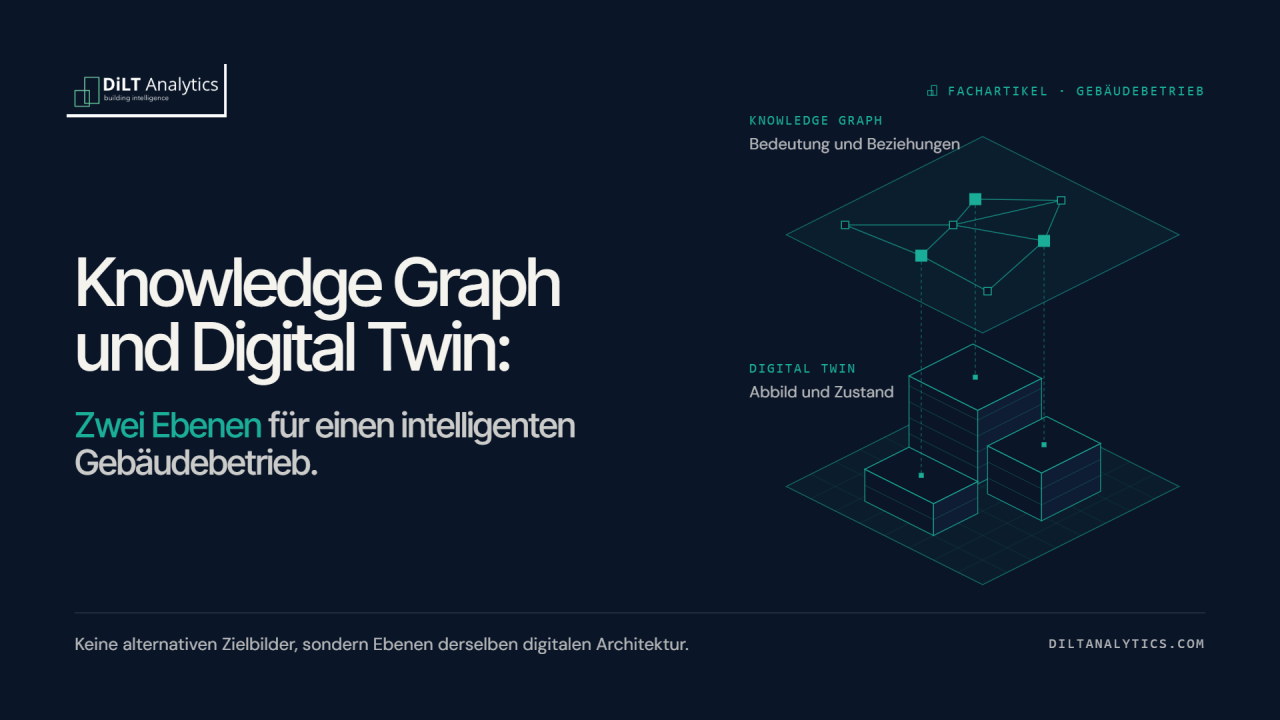
Knowledge graphs and digital twins are not competing technologies. They address different layers of a digital system: a knowledge graph structures knowledge about a real-world system and makes technical relationships explicit. A digital twin, by contrast, typically describes states, models and dynamic behaviour (Tao et al. 2019). VanDerHorn & Mahadevan (2021) discuss the terminology in detail.
This distinction matters particularly in building operations, because different use cases require a different digital foundation.
From data point to technical context
Knowledge graphs represent knowledge as a network of entities and relationships. Ji et al. describe them as structured representations of facts, consisting of entities, relations and semantic descriptions.
In building services, such a relationship might read as follows:
- Sensor 4711 measures the supply air temperature between the heating and cooling coils, in °C
- Sensor 4711 belongs to air handling unit AHU-01
- AHU-01 serves Zone A in Building B
The value does not lie in the graph structure alone. Ji et al. (2022) and Zhong et al. (2023) emphasise the importance of background knowledge, for example in the form of rules, schemas or other metadata.
For building data, this means that a measured value only gains its technical meaning through its context: what is being measured, on which component, and within which technical relationship. Storing data in knowledge graphs is therefore a core requirement for "AI-ready structures" capable of handling complex tasks in technical systems, yet in practice it is rarely used, if at all.
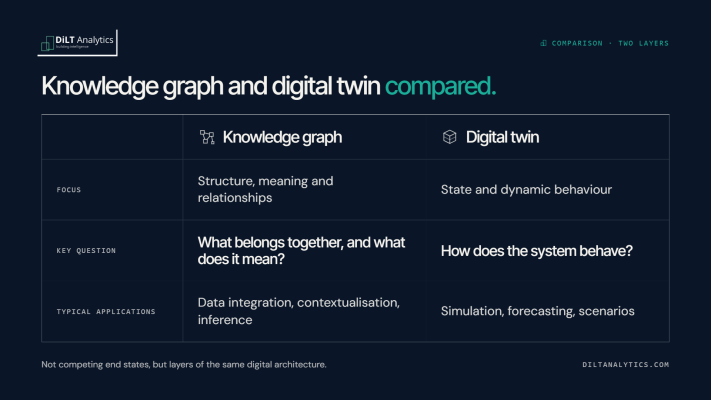
The roles of knowledge graphs and digital twins can be distinguished, in simplified terms, as follows:
 Knowledge graphs vs. digital twins
The boundaries are not rigid. Knowledge graphs can also represent temporal information and changes of state. What matters is less the dynamics of the data than the function of the respective model.
Layers that build on each other
Current research regards knowledge graphs as a central foundation for downstream applications. Karabulut et al. (2024) highlight in particular the integration of heterogeneous data sources, semantic interoperability and their role as a basis for downstream systems, explicitly including digital twins. The building example by Thomsen et al. (2026) shows how these layers can interact: the building topology and technical relationships are first described semantically using ontologies. A simulation model is then generated from this semantic model.
Put simply, the result is an architecture of semantics, system model, simulation and optimisation.
The knowledge graph provides the semantic foundation; building on it, the digital twin adds various dynamic simulation models of system behaviour for a given use case.
Not every application needs a full simulation model
For scenario analyses or simulating future operating strategies, a detailed digital twin can deliver considerable value. Building one, however, takes effort. Schmidt et al. (2026) and Thomsen et al. (2026) cite high implementation costs and dependence on expert knowledge as the main barriers to wider adoption.
Many questions in technical building operation, on the other hand, do not initially require a full simulation:
- Is a system operating according to its intended function?
- Which components are affected by a deviation?
- What technical cause explains anomalous operating behaviour?
- Which measure should be investigated?
Answering these mainly requires semantic context, technical domain knowledge and the ability to reason.
Knowledge graph or digital twin?
For intelligent building systems, framing it as a choice between the two ultimately falls short.
A knowledge graph provides the semantic layer: it describes objects, their meaning and their relationships. A digital twin can use this structure for dynamic models, enabling simulation, forecasting and scenarios at scale.
For many applications in building operations, however, and especially in existing buildings, the first essential step comes before that: generating a reliable, machine-interpretable representation of the technical system from heterogeneous building and plant data.
FaciliMind by DiLT Analytics: from semantics to technical diagnosis
This is why FaciliMind starts efficiently at the knowledge graph layer. Machine-readable measurement data and metadata are semantically enriched in an automated process and structured in a dynamic knowledge graph system. Technical objects, measured variables and relationships are linked to a domain-specific model of building services systems. The data model has been specifically optimised for automated diagnosis of complex faults.
A temperature, valve position or volume flow is therefore no longer treated as an isolated time series, but as part of a technical system.
This semantic layer is combined with rules, inference and machine learning. The architecture thus connects explicit technical knowledge with data-driven methods. Schmidt et al. attribute great importance to such combinations for traceability and quality in industrial applications.
As a result, FaciliMind can already perform analyses based on system structure, semantics and domain knowledge, adding machine learning models where they provide additional insight.
In our view, knowledge graphs and digital twins are therefore not alternative target concepts, but different layers of the same digital architecture. Which one is needed depends on the use case.
Quellen:
Ji, S., Pan, S., Cambria, E., Marttinen, P., & Yu, P. S. (2022). A survey on knowledge graphs: Representation, acquisition, and applications. IEEE Transactions on Neural Networks and Learning Systems, 33(2), 494–514. https://doi.org/10.1109/TNNLS.2021.3070843
Karabulut, E., Pileggi, S. F., Groth, P., & Degeler, V. (2024). Ontologies in digital twins: A systematic literature review. Future Generation Computer Systems, 153, 442–456. https://doi.org/10.1016/j.future.2023.12.013
Schmidt, W. J., Rincon-Yanez, D., Kharlamov, E., & Paschke, A. (2026). LLMs on the rise: Neuro-symbolic AI for knowledge graph construction in manufacturing: Systematic literature review. IEEE Access, 14, 28383–28410. https://doi.org/10.1109/ACCESS.2026.3665999
F. Tao, H. Zhang, A. Liu and A. Y. C. Nee (2019). Digital Twin in Industry: State-of-the-Art, in IEEE Transactions on Industrial Informatics, vol. 15, no. 4, pp. 2405-2415, April 2019, doi: 10.1109/TII.2018.2873186.
Thomsen, A. M. S., Bjørnskov, J., & Jradi, M. (2026). Ontology-driven digital twins for optimized recommissioning of hospital building operations. Journal of Building Engineering, 121, 115627. https://doi.org/10.1016/j.jobe.2026.115627
VanDerHorn, E., & Mahadevan, S. (2021). Digital Twin: Generalization, Characterization and Implementation. Decision Support Systems, 145, Article 113524. https://doi.org/10.1016/j.dss.2021.113524
Zhong, L., Wu, J., Li, Q., Peng, H., & Wu, X. (2023). A comprehensive survey on automatic knowledge graph construction. ACM Computing Surveys, 56(4), Article 94, 1–62. https://doi.org/10.1145/3618295